
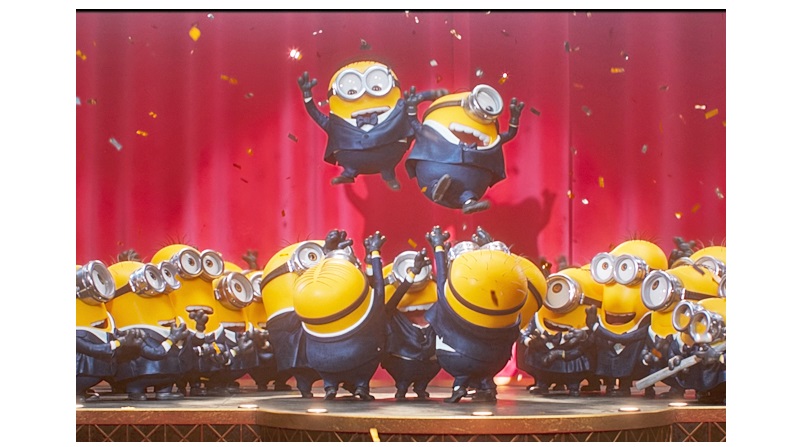
NEW YORK (AP) – When Illumination founder and chief executive Chris Meledandri earlier this month received a star on the Hollywood Walk of Fame, he wondered how many visitors it will have.
“In years to come, as people walk down Hollywood Boulevard, they’ll come across my star,” he said to the assembled crowd. “And unless they’re related to me, they’ll ask: ‘Who the hell was that guy?'”
Yet at a time of perpetual upheaval in Hollywood, the unflashy Meledandri has created and shaped one of Hollywood’s most consistent blockbuster-making operations. Family-friendly movies are fueling the box office like never before, and Illumination is at the forefront of it.
Since Illumination’s first release, 2010’s Despicable Me, the animation studio has accounted for more than USD11 billion in global box office. Its The Super Mario Galaxy Movie is the sole USD1 billion movie of 2026 so far. Illumination’s next release, Minions & Monsters, stands a good chance of equalling it.
The Minions – Illumination’s answer to Mickey Mouse or Bugs Bunny – have done a lot to drive that success. But the studio, a division of Universal Pictures, has expanded to include the Mario movies with Nintendo, an upcoming Barbie animated movie with Mattel and earlier franchises like Sing and The Secret Lives of Pets. If Illumination is synonymous with anything, it’s good cartoony fun.
"fro
m the outset, we really wanted to make films that would be joyous above everything else,” Meledandri said in an interview. “I found myself working with filmmakers who appreciated that Looney Tunes style of cartooning integrated into the creation of these animated films today.” Minions & Monsters, which opens in theatres on July 1, may be Illumination’s ultimate goofy romp. In the seventh of the Despicable Me movies and the third Minions standalone feature, the Minions become filmmakers. Minions & Monsters has the gumption to give some of the most chaos-inducing creatures, who have mishandled every diabolical device ever handed to them, a camera.
Set in the 1920s Golden Age of Hollywood, the movie has a lot of fun putting the Minions alongside silent slapstick classics like Charlie Chaplin’s Modern Times and Harold Lloyd’s Safety Last! Jeff Bridges voices a studio head. It’s the Minions’ answer to The Muppet Movie. James, the most creative Minion, is listed as its director – at least in a first draft of the end credits.
THE MINIONS GO BEHIND THE CAMERA
The movie’s real director, though, is Pierre Coffin, an Illumination veteran who has directed many of its movies and who famously voices the Minions. But Coffin has had a complicated relationship with the Minions ever-expanding world domination, and Meledandri knew he was reluctant to return. But this is an executive who, as a producer, managed to reunite the cast of DreamWorks’ Shrek for a fifth movie due out next year.
“He called me one weekend and he said, ‘You’re going to say no but I’ve got to ask,” Coffin, speaking from Paris, said. “He said, ‘It’s Minions wanting to make a monster movie. They conjure monsters but then that creation turns on them and the Earth’.”
“He got me at Minions making movies’,” added Coffin. “From that moment, I just had questions.”
The movie, opening two weeks after Pixar’s Toy Story 5, will be a new test of just how much of a powerhouse Illumination has become. After a stint running Fox’s animation division and making the Ice Age films, Meledandri founded the company, relying heavily on a group of artists at a Paris animation company then called Mac Guff. While Illumination is headquartered in Santa Monica, California, much of its movie production takes place in Paris.
With its collaborations now stretching to Japan, via Nintendo, a globalisation defines Illumination – fitting given the international word salad gibberish of the Minions.
“An objective from day one, when I started the company, was to have the complexion of creative leadership reflect our desire to make films for the entire world, as opposed to being so American-centric,” said Meledandri.
But Meledandri never set out to rival Disney or Pixar. “Those goals just felt unrealistically ambitious,” he said. Instead, Meledandri freed filmmakers and animators to make movies about antic antiheroes. He targeted subversive comedy, not poignancy. You’re likely to laugh at an Illumination movie. Crying? Not so much.
That approach has made Illumination a box-office behemoth. (Universal’s output deal with Netflix, after the movies first stream on Peacock, also boosts its films’ audience). But awards love has eluded the company. Illumination has never won an Oscar, a historical fact jokingly nodded to in Minions & Monsters. Only one release (Despicable Me 2) has been nominated for best animated feature.
But with its abiding affection for moviemaking, Minions & Monsters could find wider industry support. Even George Lucas lends his voice to the film.
MAKING BLOCKBUSTERS ON A BUDGET
Regardless, Minions & Monsters is something rare in today’s movie world: It’s almost certain to be profitable. Since producing the 2000 box-office bomb Titan A.E. at Fox, Meledandri has made fiscal discipline a religion. “Everyone’s expectation was that I would be fired,” he said. “I probably should have been fired.”
While USD200 million-plus budgets still drive many blockbusters, even big-budget filmmakers like James Cameron have warned that production costs need to be scaled down for leaner times. Minions & Monsters cost a relatively modest USD85 million to make.
Illumination’s most expensive movie, The Super Mario Galaxy Movie, cost a not-extreme USD110 million. Toy Story 5, on the other hand, carries a USD250 million budget.
“In 19 years, I cannot remember a single conversation where a director came back and said: We need more money. It’s just not part of our ethos,” Meledandri said. “It may be: How are we going to solve this problem? Or: We can’t get this done by this date. But it’s never: We need more money.”
Some in Hollywood see generative artificial intelligence (AI) as a promising new way to keep expenses down, but Meledandri isn’t sold yet. “My main focus right now is the preservation of jobs and at the expense of being the most technologically advanced,” he says. “It always feels better to be part of a front of a wave as opposed to a Luddite. But in this case, we’re not pushing AI into our pipeline.”
“I do not believe that a sufficient answer is, ‘Well, we’ve had technological advances before and people were worried yet it all was fine and things kept surging forward,'” Meledandri continues. “None of those other technologies had agency.”
Animation big wigs have often been ubiquitous presences. But neither Jeffrey Katzenberg, of DreamWorks, nor John Lasseter, of Pixar, remain at the animation studios they once defined. The 67-year-old Meledandri, who grew up on Manhattan’s Upper East Side, is the unlikely heavyweight – the “big boss” of the Minion empire.
His entry to the movie business first began when a customer of his father’s men’s clothing store hired him as an assistant on Footloose. His second big break came producing the 1993 Disney hit Cool Runnings. Now he finds himself running a once-underdog animation studio with an almost unblemished track record.
The competition that worries him isn’t Disney or Pixar, though, but short-form content.
“It’s got to force us to be more imaginative and more surprising and to reach further than storytelling that could feel safe because it’s worked before,” said Meledandri. “In Minions & Monsters, what Pierre Coffin has done is made a movie that is so wildly imaginative and unexpected that it’s exactly where I would wish Illumination to be in this moment in time.” – Jake Coyle
Courtesy of Borneo Bulletin