
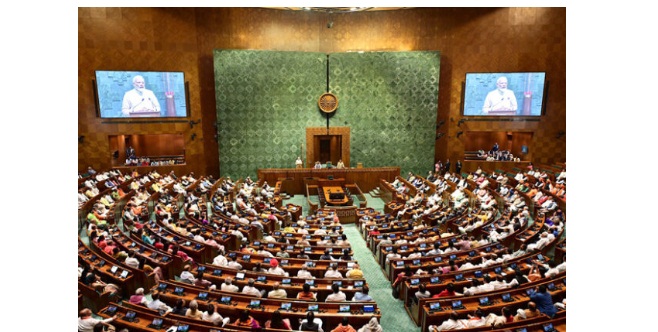
NEW DELHI (AFP) – A proposal to expand India’s Parliament to increase the number of women representatives fell through after the ruling coalition failed to secure enough votes for it in the Lower House.
Women currently account for 14 per cent of the 543-seat Lok Sabha, the Lower House of Parliament in the world’s largest democracy of 1.4 billion people.
While boosting the number of women lawmakers has broad support in principle across the political spectrum, critics argued that achieving it by increasing the overall number of seats would primarily benefit Prime Minister Narendra Modi’s party.
Modi’s government convened a special sitting of Parliament this week, hoping to pass several landmark bills that could overhaul India’s parliamentary system, including the proposal to fast-track the implementation of a 2023 law reserving 33 per cent of Lok Sabha seats for women.
In order to do so, the government said it planned to redraw parliamentary districts based on population, increasing the number of Lower House seats to more than 800.
In a Friday vote, the bill failed get a two-thirds majority and did not pass, Parliament Speaker Om Birla said. Two other related bills were shelved as a result.
Opposition parties and critics have said that expanding seats in Parliament would benefit states in the densely populated north, where Modi’s Hindu nationalist Bharatiya Janata Party (BJP) enjoys widespread support.
Opposition parties, which control states in southern India where the population is lower, fear they would lose overall power in Parliament.
Lawmaker Jairam Ramesh from the opposition Congress Party hailed the defeat of what he called a “nefarious” attempt to link “dangerous delimitation proposals to women’s reservation”.
Instead, Ramesh said in a social media post, the government should implement the 33-per-cent quota “in the existing set up of the Lok Sabha for the 2029 Elections”.
-- Courtesy of Borneo Bulletin