
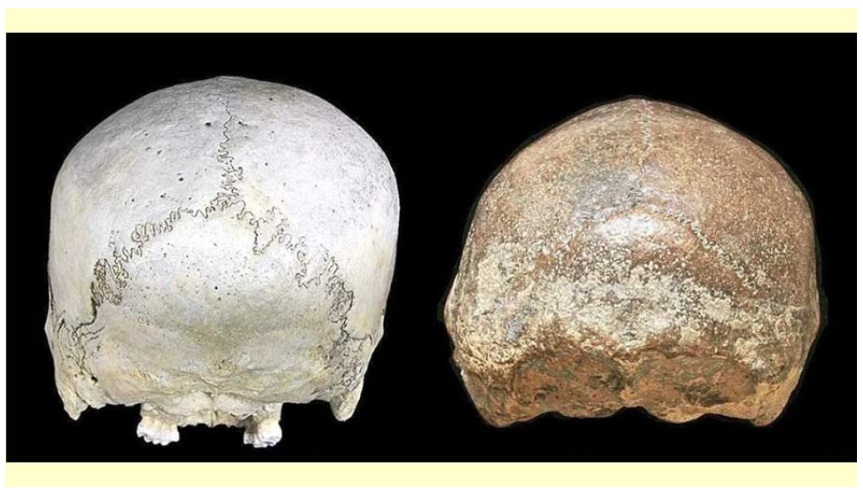
TOKYO (ANN/THE JAPAN NEWS) – Early humans living more than 100,000 years ago may have been born just as physically helpless as modern human babies, requiring care and support from others to survive, according to an international study involving researchers from the University of Tokyo.
The study focused on Homo erectus, commonly known as Java Man, and found evidence suggesting newborns were unable to hold up their heads at birth, much like infants today.
Researchers examined fossilised skulls and discovered deformities believed to have formed when the infants lay on one side for extended periods. The findings indicate that caregivers likely played an essential role in raising these vulnerable infants.
Unlike most primates, which can support their heads shortly after birth, human babies require significant assistance and have relatively soft skulls. Scientists believe this is linked to the evolution of upright walking, which narrowed the mother’s birth canal and resulted in babies being born at an earlier stage of development.
However, it has remained unclear when this trait first emerged during human evolution.
The research centred on deformational plagiocephaly, or flat head syndrome, a condition in which the skull becomes asymmetrical due to prolonged pressure on one side. More than 1,500 skulls from humans, chimpanzees, gorillas and other species were analysed, with researchers concluding that the condition serves as an indicator of physical helplessness during infancy.
Similar skull deformities were identified in Java Man fossils dating back about 110,000 years, as well as in Homo floresiensis, which lived around 60,000 years ago.
The team ruled out the possibility that the distortions resulted from geological pressure after burial, citing excavation conditions and the degree of bone deformation. The findings have been published in a scientific journal.
“We can imagine that Java Man also exhibited behaviours similar to those of modern humans in childbirth and child-rearing,” said Professor Yousuke Kaifu of the University of Tokyo, a member of the research team and an expert in human evolutionary biology.
Takashi Nara, a professor of physical anthropology at Niigata University of Health and Welfare, described the study as offering a new perspective by linking skeletal distortions in archaic human remains to changes occurring after birth.
He said the findings provide valuable insights into the evolution of human development and caregiving.
Courtesy of Borneo Bulletin